> ## Documentation Index
> Fetch the complete documentation index at: https://docs.intelligence-management-platform.com/llms.txt
> Use this file to discover all available pages before exploring further.
# Budgets
> Set and manage spending limits per user, role, team, project, or agent — enforced by LiteLLM.
export const RightsCallout = ({right, flags}) =>
Who sees this: requires {right === "none" ? "no special rights — available to every signed-in user" : `the ${right} right (or super admin)`}.
{flags && flags !== "none" ? ` Only visible when the server enables ${flags}.` : ""}
;
Budgets are enforced by LiteLLM, which is the authoritative source of truth for all budget data. IMP's Budgets page is a management interface that reads from and writes to LiteLLM's budget API. Reset dates are standardized UTC calendar boundaries (start of day, week, or month in UTC) set via LiteLLM budget endpoints.
## What the budgets page is
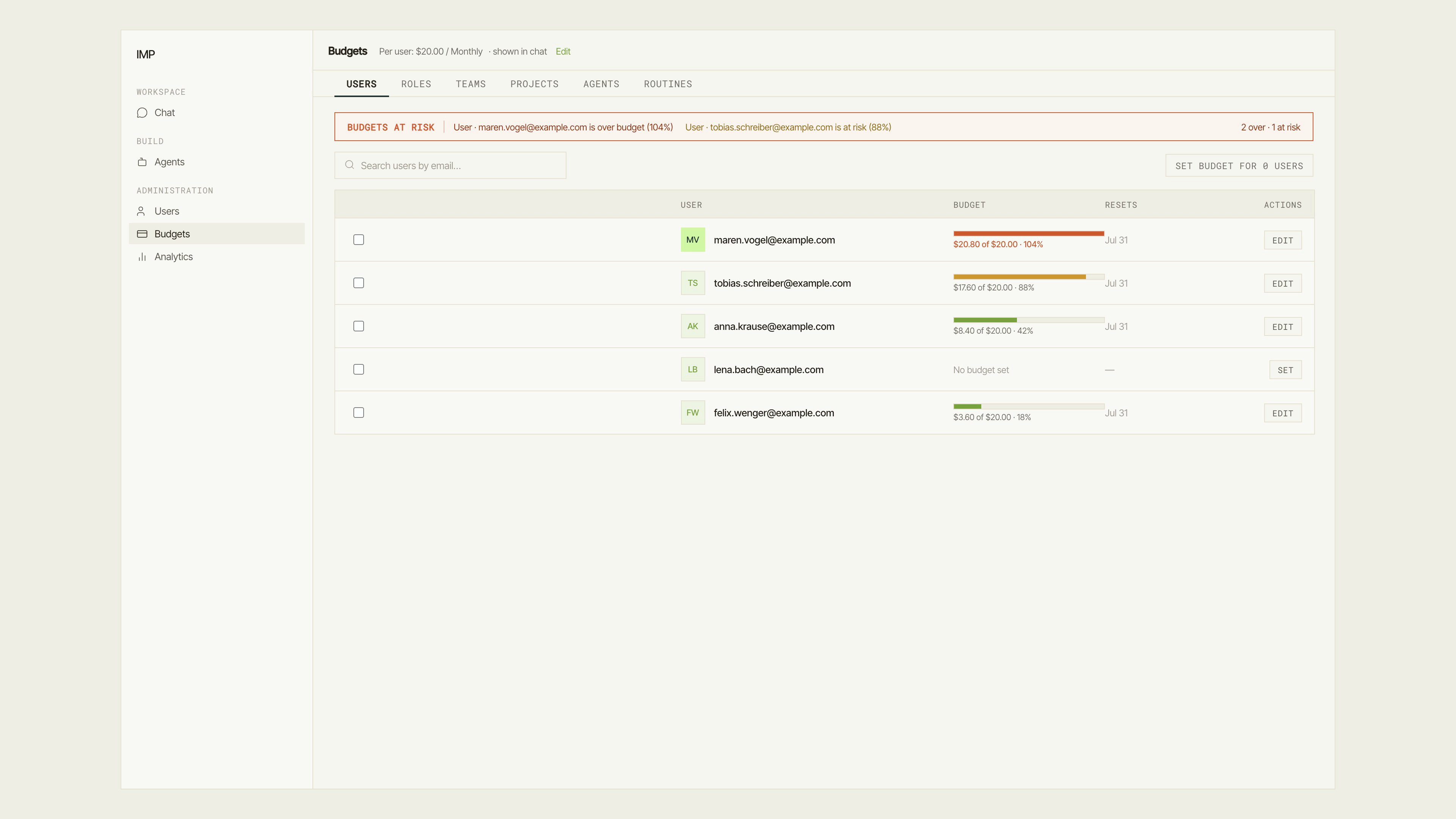
The **Budgets** page (`/budgets`) lets you set spending caps on any entity that consumes model tokens: individual users, roles, teams, projects, or agents. Budgets are expressed in USD and enforced at request time by the LiteLLM proxy — when an entity reaches its limit, further model requests are blocked until the period resets.
 ## Entity types
The page has a tab strip to switch between entity types:
| Entity type | What gets a budget |
| ------------ | ------------------------------------------------------------- |
| **Users** | Individual users by email. |
| **Roles** | Every user who holds the role shares the role's budget pool. |
| **Teams** | Every user on the team shares the team's budget pool. |
| **Projects** | Sessions inside a project count against the project's budget. |
| **Agents** | Calls to a specific agent count against the agent's budget. |
| **Routines** | Routine runs count against the routine's budget. |
Use **Search `{type}` by name…** in the toolbar to filter within a type.
## Budgets at risk
The **Budgets at risk** strip appears at the top of the page when one or more entities are over or near their budget. Each item shows the entity type, name, and the percentage consumed (e.g., "User · [alice@example.com](mailto:alice@example.com) is over budget (104%)"). Clicking an item scrolls to that row in the table.
When all entities are within their limits, the strip shows "All budgets on track."
## Budget editor
Click **Edit** on any row (or **Set** if no budget exists yet) to open the budget editor. The editor fields are:
| Field | What it sets |
| ---------------- | --------------------------------------------------------------------------------------------------------------------------------------------------------------- |
| **Budget (USD)** | The spending cap in US dollars for the period. |
| **Reset period** | Daily, Weekly, or Monthly. |
| **Reset date** | The specific UTC calendar boundary when the period begins. Defaults to the start of the current day, week, or month. Pick a different date to shift the window. |
The editor also shows the **Current status** of the budget if one is already set: the amount spent so far, the cap, and the projected spend by reset.
Click **Save budget** to commit. Click **Remove** to delete the budget and let the entity spend freely until a new one is set (a confirmation dialog describes the effect).
### Bulk apply
Select multiple rows with the checkboxes in the table. The selection bar offers **Set budget for `{count}` `{type}`** which opens the budget editor in bulk mode. The same amount, reset period, and reset date are applied to every selected entity. Partial failures are reported per-item.
## Default budget policy
The **Default budget policy** link (shown as a summary line above the table, e.g., "Per user: \$20.00 / Monthly") opens a dialog that sets organization-wide defaults:
**Default per-user budget section:**
* **Enable a global per-user budget** — toggle to activate the default.
* **Default budget (USD)** — the amount applied automatically to new users who have no explicit budget.
* **Reset period** — Daily, Weekly, or Monthly.
**Visibility section:**
* **Show budget status to users** — when enabled, users see a **Budget `{percent}`%** chip in the application's top bar.
* **Budget display** — choose whether users see the exact amount spent ("Exact amount (\$)") or only a percentage ("Percentage only").
Click **Save** to apply. Changes take effect for new budget checks immediately; existing budget records for individual users are not retroactively changed by the default.
The audit trail for policy changes is not yet available — who changed the policy and when is not recorded. This is a known gap.
## How budgets reset
Budgets reset at the UTC calendar boundary set in the editor:
* **Daily** — start of the UTC day (00:00 UTC).
* **Weekly** — start of the UTC week (Monday 00:00 UTC).
* **Monthly** — start of the UTC month (first of the month, 00:00 UTC).
Custom reset dates set an explicit boundary within the chosen period. All resets are managed by LiteLLM.
## Next steps
Assign roles and teams that budgets apply to.
View spend trends that drive budget consumption.
How users see their budget in the chat interface.
## Entity types
The page has a tab strip to switch between entity types:
| Entity type | What gets a budget |
| ------------ | ------------------------------------------------------------- |
| **Users** | Individual users by email. |
| **Roles** | Every user who holds the role shares the role's budget pool. |
| **Teams** | Every user on the team shares the team's budget pool. |
| **Projects** | Sessions inside a project count against the project's budget. |
| **Agents** | Calls to a specific agent count against the agent's budget. |
| **Routines** | Routine runs count against the routine's budget. |
Use **Search `{type}` by name…** in the toolbar to filter within a type.
## Budgets at risk
The **Budgets at risk** strip appears at the top of the page when one or more entities are over or near their budget. Each item shows the entity type, name, and the percentage consumed (e.g., "User · [alice@example.com](mailto:alice@example.com) is over budget (104%)"). Clicking an item scrolls to that row in the table.
When all entities are within their limits, the strip shows "All budgets on track."
## Budget editor
Click **Edit** on any row (or **Set** if no budget exists yet) to open the budget editor. The editor fields are:
| Field | What it sets |
| ---------------- | --------------------------------------------------------------------------------------------------------------------------------------------------------------- |
| **Budget (USD)** | The spending cap in US dollars for the period. |
| **Reset period** | Daily, Weekly, or Monthly. |
| **Reset date** | The specific UTC calendar boundary when the period begins. Defaults to the start of the current day, week, or month. Pick a different date to shift the window. |
The editor also shows the **Current status** of the budget if one is already set: the amount spent so far, the cap, and the projected spend by reset.
Click **Save budget** to commit. Click **Remove** to delete the budget and let the entity spend freely until a new one is set (a confirmation dialog describes the effect).
### Bulk apply
Select multiple rows with the checkboxes in the table. The selection bar offers **Set budget for `{count}` `{type}`** which opens the budget editor in bulk mode. The same amount, reset period, and reset date are applied to every selected entity. Partial failures are reported per-item.
## Default budget policy
The **Default budget policy** link (shown as a summary line above the table, e.g., "Per user: \$20.00 / Monthly") opens a dialog that sets organization-wide defaults:
**Default per-user budget section:**
* **Enable a global per-user budget** — toggle to activate the default.
* **Default budget (USD)** — the amount applied automatically to new users who have no explicit budget.
* **Reset period** — Daily, Weekly, or Monthly.
**Visibility section:**
* **Show budget status to users** — when enabled, users see a **Budget `{percent}`%** chip in the application's top bar.
* **Budget display** — choose whether users see the exact amount spent ("Exact amount (\$)") or only a percentage ("Percentage only").
Click **Save** to apply. Changes take effect for new budget checks immediately; existing budget records for individual users are not retroactively changed by the default.
The audit trail for policy changes is not yet available — who changed the policy and when is not recorded. This is a known gap.
## How budgets reset
Budgets reset at the UTC calendar boundary set in the editor:
* **Daily** — start of the UTC day (00:00 UTC).
* **Weekly** — start of the UTC week (Monday 00:00 UTC).
* **Monthly** — start of the UTC month (first of the month, 00:00 UTC).
Custom reset dates set an explicit boundary within the chosen period. All resets are managed by LiteLLM.
## Next steps
Assign roles and teams that budgets apply to.
View spend trends that drive budget consumption.
How users see their budget in the chat interface.